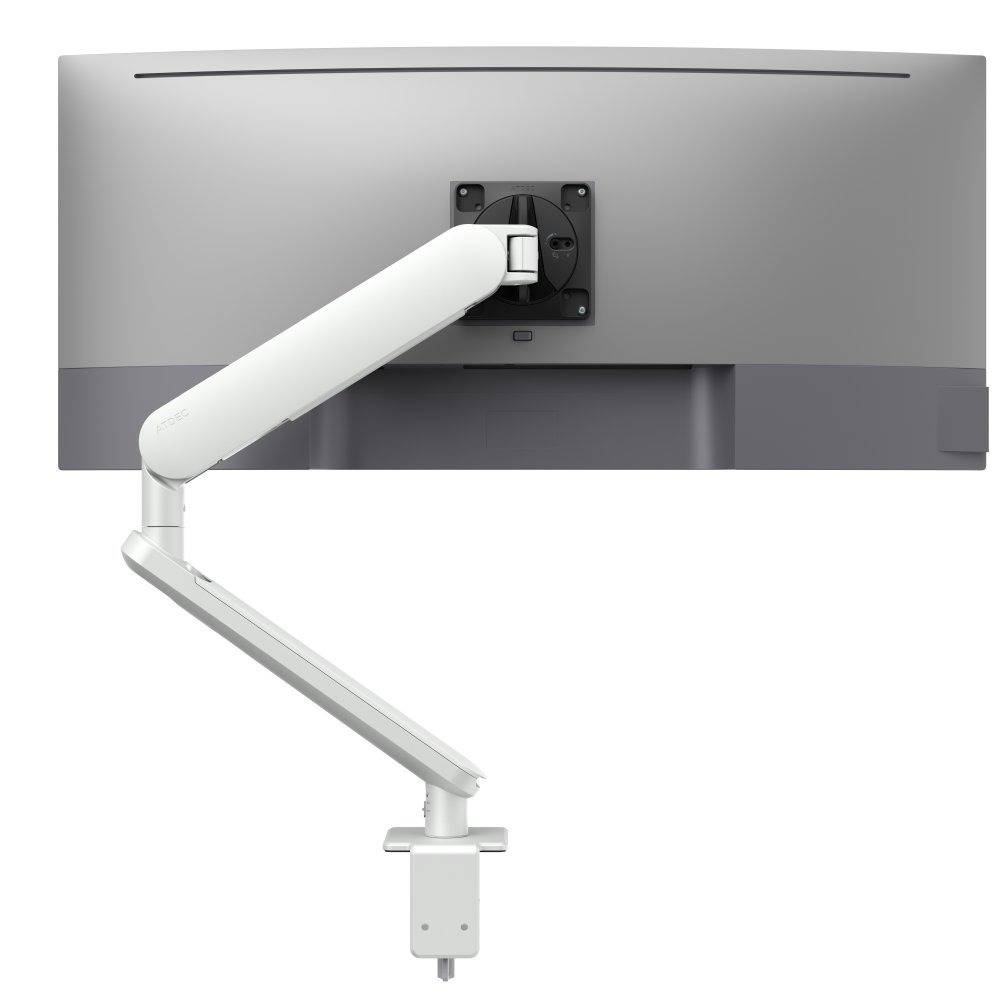
Ora monitor arm for hybrid office desks
Hybrid work has changed what a desk has to do. A single workstation might serve three people in a week, move between sitting and standing several times a day, and carry a different monitor each quarter as displays are refreshed. The mount holding that screen is no longer a fixed accessory; it is the part of the setup that absorbs all of this movement and reassignment without losing tension, alignment, or reach.
Atdec Ora is a premium single monitor arm built for this kind of workspace. It is tested and rated to hold displays up to 38-inch, curved or flat, from 2–8kg or 4.4–17.6lb, and it ships complete and ready to deploy. The sections below answer the questions workspace managers most often ask when specifying arms for hybrid, hot-desking, and sit-stand environments.
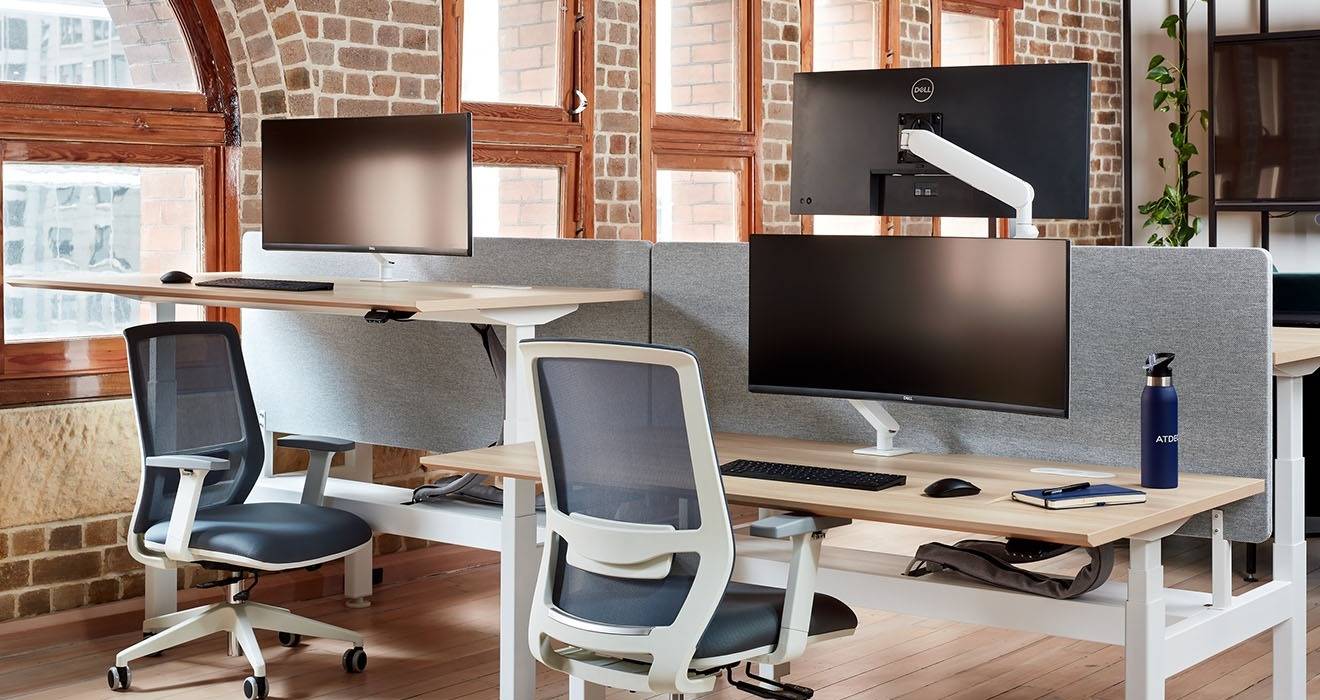
What desk monitor arms work best for hot-desking and hybrid offices?
Hot-desking asks two things of a monitor arm that a fixed desk does not: it has to be adjusted quickly by whoever sits down next, and it has to survive being adjusted thousands of times. Monitor arms that suit these spaces share a short list of traits: toolless adjustment, counterbalance that holds position without drifting, rotation limiter that protects adjacent screens and partitions, and a clamp or desk fixing that fits whatever surface the desk happens to have.
Ora addresses each of these directly. Tilt, pan, and height adjust by hand, so a new user sets their own position in seconds. The counterbalance holds the screen where it is placed rather than sagging over a shift. A 180-degree rotation limiter, a finger-flick switch like a light, is standard on every unit stops a swung monitor from clipping the screen beside it, which matters on the tight desk spacing typical of hot-desking floors. The F-clamp accommodates worksurfaces from 0–70mm or 0–2.76" its benches, shared desks, and touchdown points across a fitout. Other clamps and desk fixing are available.
For a large rollout, the practical advantage is speed. Ora carries an easy-to-read counterbalance gauge designed for bulk deployment, so an installer sets the same tension quickly across dozens of desks and gets a consistent result each time.
Which monitor arms are best for height-adjustable sit-stand desks?
On a sit-stand desk the arm travels with the worksurface, so the priority shifts. What matters is a mount that holds its counterbalance through repeated raising and lowering, and that gives the user enough independent vertical range to fine-tune eye height at both the seated and standing positions.
Ora offers 315mm or 12.4" of dynamic vertical range and a tilt range of +45 degrees to -20 degrees, which is enough to keep the top of the screen at eye level whether the desk is low or raised, even for taller people.
One point on load. The best arm for a sit-stand desk is one rated for the monitor it will actually carry, not one chosen for headroom above the display's weight. Ora is fully functional across its entire 2–8kg or 4.4–17.6lb range, for screens to 38-inch. A screen anywhere in that band is held at a set tension and holds its position through the desk's full travel. Match the arm to the display, confirm the mount is VESA-compatible (Ora supports 75x75 and 100x100), and the sit-stand behaviour looks after itself.
Single or dual monitor arm for office workstations?
Although preference plays a part, the answer depends on the role. A single arm suits most hot-desks, touchdown spaces, reception, and any laptop-plus-one-screen setup, where a second display goes unused and only serves to reduce usable desk depth. A dual arm suits finance, trading, software, design, and monitoring roles, where two (or more) screens are worked continuously and the productivity gain is real and measurable.
The trade-offs are practical. A single arm frees more of the worksurface and is quicker to reassign in a shared space; a dual arm consolidates two screens on one clamp point and keeps them aligned, but needs adequate desk depth and a heavier base. For an estate with a mix of both, the sensible approach is to source single and multi-screen mounts from one engineering family so parts, clamps, and finishes stay consistent across the floor.
That is where the Atdec Workspace range fits. Ora covers the premium single-monitor case as a complete, deployable product. Atdec Modular, the flagship of the range, is a component-based system that configures into any arrangement required, from dual arms to the dense multi-screen layouts used in trading floors and control rooms. Because Atdec Modular solutions are configured to the application, a given build is assembled from shared components rather than shipped as a single fixed kit; specify it with your supplier so the configuration and any assembly documentation match what the site actually needs.
Ora and Atdec Modular are aesthetically aligned to deliver a unified visual harmoney to the office.
Choosing a monitor and display mount range for a mixed estate
Workspace managers, and the partners who supply them, are usually choosing a range rather than a single part. A coherent range is worth more than the sum of its products, and the criteria that separate a good one are consistent across every buyer.
Tested and stated specifications come first. Ora's display size, weight range, and worksurface fit are explicitly tested and published, so a specifier is not left guessing at a larger screen or a thicker desk. A single, clear warranty matters next; Ora carries a 10-year limited warranty that covers the full commercial lifecycle of most fitout projects. Design pedigree signals engineering quality to end users: Ora holds iF, Red Dot, Good Design (Australia, Japan, and Korea), Chicago Athenaeum, and Spark awards. Finally, a range that spans single, dual, and fully modular configurations from one family lets a buyer meet every workstation type without switching vendors, which keeps clamps, finishes, and support consistent across a whole estate.
Ora at a glance
- Type: premium single monitor arm, desk-mounted
- Display size: up to 38-inch, curved or flat
- Weight range: 2–8kg or 4.4–17.6lb
- Tilt: +45 degrees to -20 degrees
- Rotation: plus or minus 90 degrees
- Rotation limiter: 180 degrees, toolless
- Horizontal reach: 645mm or 25.4"
- Dynamic vertical range: 315mm or 12.4"
- VESA: 75x75 and 100x100
- Worksurface thickness: to 70mm or 0–2.76"
- Warranty: 10 years limited