
Ceiling mounts for double-sided retail signage
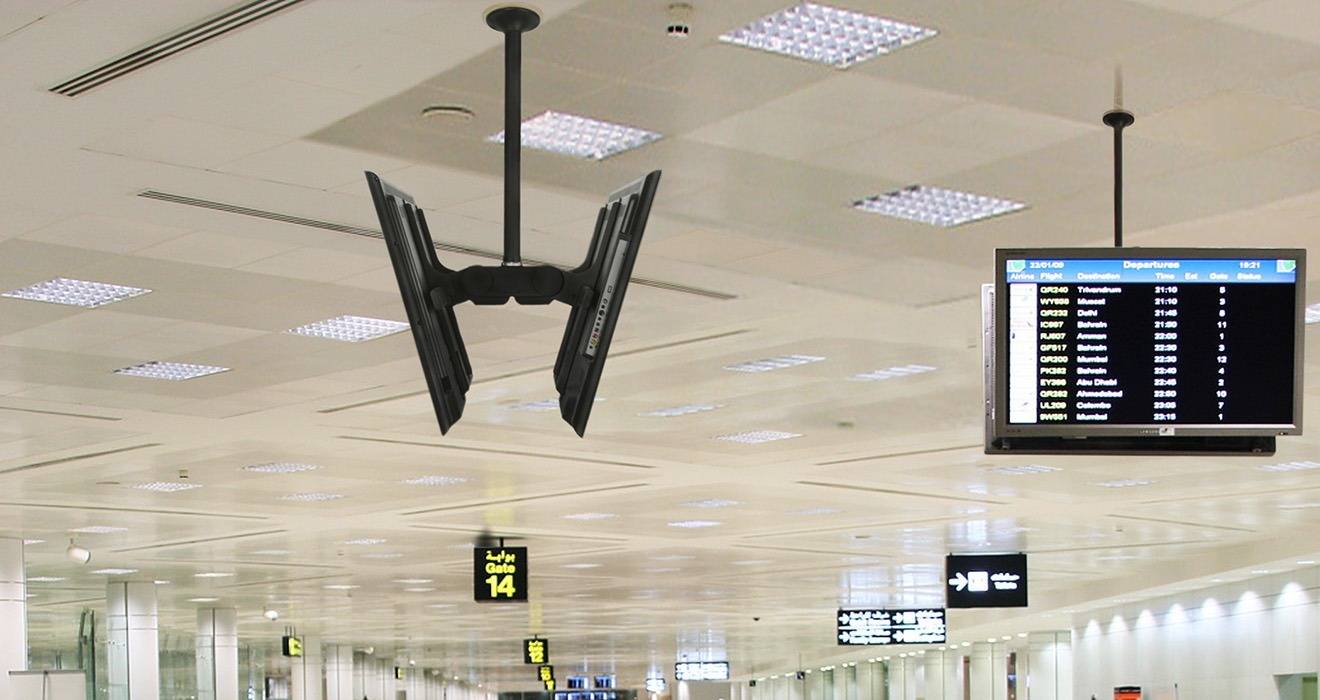
Why a second screen changes the engineering
A back-to-back pair is not two separate mounts. It is one pole carrying two independently rated heads, so the way to specify it is per head: match each head's rated capacity to the display it will carry, with margin, exactly as you would for a single screen. Atdec rates capacity per head rather than as a single lumped figure, which keeps the specification honest, because every screen is checked against the capacity that actually holds it.
What does change with a second screen is the demand on the ceiling. The fixing point now supports the total installed weight, both displays, the pole, and the heads, so the structure above the ceiling has to be adequate for that total even though the mount itself is rated per head. Getting the per-head capacity right protects the screens; confirming the structure protects the whole installation.
Mounting stability: what actually holds it up
Three things determine whether a double-sided mount stays exactly where it was installed: the structure above the ceiling, the per-head capacity, and the quality of the fixing hardware.
The structure above matters most. A ceiling mount transfers all of its weight into whatever it is fixed to, so the attachment point needs to reach solid structure, whether a joist, a beam, a steel channel, or a rated ceiling box, rather than plasterboard alone. Suspended and false ceilings are common in retail and need a fixing that reaches genuine structure above the tiles; where a standard mount does not suit the ceiling, the ADB modular digital signage range can be configured to the site.
Per-head capacity is how Atdec rates its mounts, and it is the figure to specify against. Atdec's TH-1040-CT products (short TH-1040-CTS and long TH-1040-CTL versions) carries up to 25kg or 55lb per head and converts to a back-to-back pair with the TH-1040-CT-B2B accessory, which suits most medium displays in the 24 to 46-inch range. That is the most popular ceiling mount Atdec offers, with alternatives available for larger and heavier screens.
Hardware quality is an often overlooked factor that is significant to longevity. Mounting hardware is included with ADB components, and the range carries a 10 year warranty, which matters when a mount is expected to outlast several display refresh cycles.
Installation needs
Most retail double-sided installations are handled by an integrator or a competent fit-out contractor, and a few practical factors decide how smoothly that goes.
Drop length is the first. Ceiling height and sightlines determine how far the display should hang, so the pole needs a telescopic range that lands the screens at eye level for the people meant to read them. Atdec's medium-display mounts come in two pole lengths, short pole TH-1040-CTS has a range 400 to 900mm (or 15.75 to 35.43 inches), and the long pole TH-1040-CTL from 900 to 1800mm (or 35.43 to 70.87 inches).
Cable management is the second. Two screens mean two sets of power and data cables, and in a retail environment they need to disappear. Cables run internally through the pole, with a dress cover concealing the ceiling connection, so the finish reads as a clean line rather than a bundle of leads.
Orientation and aim come last, and this is where a good mount earns its place. Each head rotates 360 degrees around the pole, tilts and pans up to 20 degrees, and switches between landscape and portrait, so both faces can be set independently once the displays are live. TH-1040-CT products have VESA compatibility up to 200x200, which covers the mounting hole patterns on the large majority of commercial panels; confirming the panel's VESA pattern before ordering avoids the most common day-of-install surprise. VESA adaption plate accessories are also available for larger VESA within the weight capacity.
Planning for reconfiguration
Retail layouts rarely stay still, and it pays to know which of the two approaches suits how much you expect to change.
A standard single-display mount from the TH-1040-CT family covers the common change. A location fitted for one screen today can take a second, back to back, by adding the second-display accessory TH-1040-CT-B2B, or a dual vertical stack by pairing that accessory with the vertical bracket kit TH-1040-CT-RCK. That is the limit of what these mounts do: they add a head, they are not fully modular.
When the format is likely to change more than that, the ADB modular digital signage range for ceiling mounts is the answer. It builds any arrangement from interchangeable pole, rail, and bracket components, from a single screen to a multi-screen video wall suspended from the ceiling, and reconfigures without a new custom design each time. It is also serviceable at scale; a single screen or bracket can be replaced without dismantling the whole structure, which protects the investment when one panel fails or the layout changes.
How to choose a double-sided ceiling mount
Four questions settle most specifications:
- Display size and weight. Match each head's rated capacity to the heaviest display that face will ever carry, with margin. Medium displays to 25kg or 55 lb point to the TH-1040-CT family; larger or heavier screens to the TH-3070-CT family.
- Ceiling type and height. Solid structure, suspended, or false ceiling; then the drop length that puts screens at reading height. This decides pole length and whether the site needs an ADB modular configuration rather than a standard mount.
- Now or later. If a second face is likely but not immediate, start with a single mount that accepts the back-to-back accessory rather than committing to a fixed dual assembly.
- Orientation. Confirm landscape or portrait for each face, and check the panel's VESA pattern against the mount's range before ordering.